



Walk down any busy Nigerian avenue, and you’re strolling by means of an financial system. Someone is welding a gate. Someone is sitting behind a POS machine below an umbrella. Someone is working a kitchen out of a entrance room and feeding half the road by lunchtime.
The nation’s repute for enterprise is not flattery we pay ourselves. Nigeria has roughly forty million businesses. Only India and Indonesia are reckoned to have extra. Whatever else has gone flawed right here, Nigerians haven’t stopped beginning issues.
But kind these businesses by measurement, utilizing the lessons the nationwide survey itself makes use of, and the image turns unusual. Of the 39.7 million enterprises within the final depend, 33 million are nano businesses, that means one or two folks. Another 5.9 million are micro, with three to 9.
That leaves 617,248 small companies. And 53,199 medium sized ones, the type with a actual payroll and a steadiness sheet a financial institution may learn.
That is one enterprise in each 745. Nigeria is a nation crowded with businesses and almost empty of corporations.
The distinction is not a matter of phrases. A enterprise is one individual’s residing. An organization is a factor that outlasts the week: it carries employees, buys machines, indicators contracts it may be sued over, and retains books that somebody exterior the household can verify. Almost all the things a trillion greenback financial system is product of comes from the second variety.
The take a look at is what a agency can do, not what it is known as. A enterprise might be completely effectively included and nonetheless be one individual’s residing, and a nice many Nigerian corporations are precisely that.
You can see what the scarcity prices us in a single comparability. Nigeria’s micro, small and medium companies present about 88% of all employment and a little below half of nationwide output. They account for roughly 6% of what the nation sells overseas. So they carry almost 9 jobs in each ten, and virtually none of what Nigeria sells to the world.
Medium-sized companies are the place an financial system learns to do issues correctly. They are massive sufficient to purchase a machine and hold it busy, to make use of somebody whose solely job is high quality, to fulfill a international purchaser’s normal after which fill the repeat order that follows. A person promoting from a tray can not do any of that, nevertheless laborious he works. There is no association of forty million trays that provides as much as an trade.
That is a declare about functionality and never about advantage. Size doesn’t make a agency good. It makes sure sorts of excellent potential.
The regular clarification for all this is cash, and it is a good clarification so far as it goes. I’ve written right here about a monetary system that finds it simpler to lend to the federal government than to a producer. The latest World Bank survey of Nigerian companies bears it out: 28% of small companies say getting finance is the only greatest impediment they face. That survey covers formal companies of 5 workers or extra, so the companies from right here on are the bigger, countable kind.
But observe that quantity up the scale ladder and it comes aside in your fingers. Finance is the largest impediment for 28% of small companies, 16% of medium ones, and 1.7% of huge ones.
Both issues are true without delay. The nice mass of small and casual businesses is starved of credit score. The few companies that attain measurement have largely solved it.
So credit score explains why a Nigerian enterprise struggles. It doesn’t clarify why so few of them ever cross over.
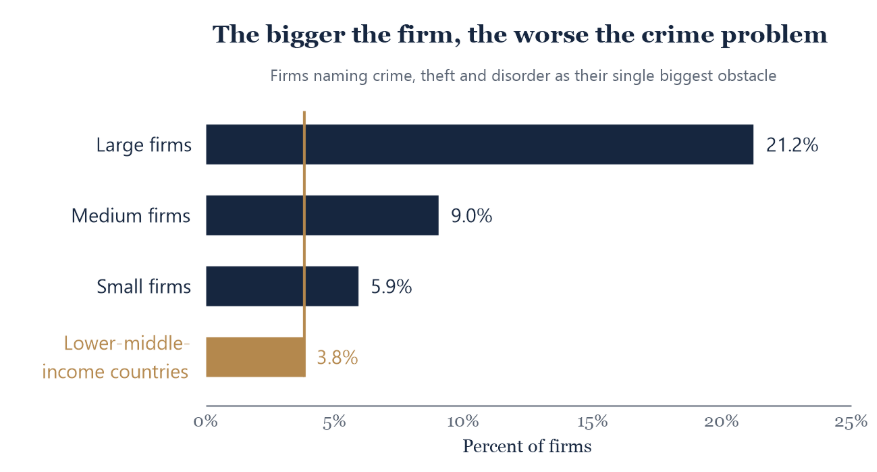
Something else is ready on the opposite aspect. Ask Nigerian companies to call their single best impediment and crime is chosen by 6% of small companies, 9% of medium companies, and 21% of huge ones. Corruption climbs the identical staircase, from 6% to fifteen%.
Growth doesn’t carry the burden. It modifications which burden you carry.
That query has a lure in it. It asks companies to rank their troubles, to not measure them. When finance stops being a massive agency’s worst downside, one thing else takes the title.
So look as a substitute at what companies spend. Spending is a measurement, not an opinion. The solely Nigerian figures of this type are previous: they arrive from the survey spherical of 2014 and 2015, as a result of the 2025 spherical stopped asking.
In that spherical, safety price small companies 3.9% of their gross sales, medium companies 4.8% and enormous companies 6.3%. Their losses to theft and vandalism ran the opposite manner, falling from 1.8% right down to 0.7%.
Larger companies purchase extra safety and are robbed much less for it. That is the studying, not the discovering: the survey data what companies spent and what they misplaced, and leaves the explanation to us.
One in 5 massive Nigerian corporations now says crime is the worst factor it faces. In nations at a comparable revenue degree, fewer than 4 in a hundred say so.
Why ought to getting bigger appeal to bother? Because bigger is seen, and on this nation visibility is the factor that prices.
The similar survey requested companies whether or not they had been registered after they first opened. Among small companies, 47% had been. Among massive companies, 78% had been.
Nigerian businesses don’t usually begin formal after which develop. They develop first and floor later, in the event that they floor in any respect.
An unregistered enterprise is more durable to tax, more durable to examine, more durable to levy and more durable to search out, and each a kind of is value actual cash to the one that owns it.
Nigerians have already got a title for what comes subsequent. Multiple taxation: the federal income service, the state, the native authorities, then the levies for signage and refuse and setting, then the collectors on the gate whose authority no one can set up. Each one is survivable by itself. Together they’re what it prices to be discovered.
Here is the half that issues most. Everything a agency pays for becoming seen arrives without delay, and all the things it was promised in return arrives later, if in any respect. The evaluation comes this quarter. The credit score, the safety, the court docket that may implement your contract, these are available in another yr.
Set in opposition to that sequence, staying small is not a failure of nerve. It is a appropriate studying of the phrases on provide.
This sequence has made a model of that argument earlier than, about merchants who won’t register and landowners who won’t title. What the agency information provides is more durable. The penalty doesn’t cease on the door. It grows with you.
The authorities has improved these phrases, and deserves the credit score. Since January, below the brand new tax acts, a qualifying small firm pays no firm revenue tax, no capital features tax and no improvement levy.
If tax had been the entire of the issue, companies would now be surfacing in numbers. It is too early to know. But the reform reaches the a part of the invoice that was written down, and the remainder of the invoice was by no means on a type: the levies, the visits, the safety invoice. None of that has moved.
None of this displaces the issue Nigerian companies title most frequently, which is electrical energy. It leads the listing at each measurement, and at 37% it weighs heaviest on the biggest companies of all. That is the generator financial system, exhibiting the identical gradient.
Power is the heavier burden. The distinction is not weight however certainty: a agency can worth a generator and the diesel to run it, and it can not worth the danger of being observed.
The different aspect of this argument deserves its strongest type. Economists have argued for years about whether or not a lacking center exists in any respect.
Hsieh and Olken examined India, Indonesia and Mexico and located no hole in the course of the agency measurement distribution. What they discovered as a substitute was a easy slope, working from very many tiny companies right down to only a few massive ones. Work on African information has reached a lot the identical conclusion concerning the form.
They are proper concerning the form, and it doesn’t rescue us. The sharper query was by no means whether or not there is a gap in a chart. It is whether or not medium sized companies carry the share of the work that an financial system wants them to hold, and in Nigeria they plainly don’t.
A World Bank examine of 4 African nations discovered exactly that, and located one thing extra helpful moreover. The scarcity doesn’t come from companies being born too small. It comes from companies not rising.
Nigerian enterprises usually are not failing to start out. They are failing to get bigger.
What that prices is not summary, and it doesn’t fall on enterprise house owners. About 92% of employed Nigerians work informally, and amongst employed girls it is 96%. Informal work means no contract, no discover, no pension and no declare on anyone in case you fall ailing.
A job inside a actual firm is probably the most atypical type of safety an financial system can provide a family, and Nigeria has few of them to present. That is what the lacking center truly means. Not a curiosity about agency measurement. A working life with no ground below it.
The different aspect of the lacking center is what occurs on the uncommon events a enterprise does attempt to cross it. When a Nigerian firm goes wanting for critical cash, someone from exterior lastly examines it carefully, typically for the primary time in its life.
I’ve spent most of my profession being that individual. The downside almost at all times arrives in the identical form.
The accounts are audited and the auditor has signed them with out reservation. That appears like the tip of the matter. It is not.
An audit checks that what the corporate says occurred did occur. An investor is asking one thing completely different: how a lot of this revenue will nonetheless be there after I’ve paid for it, and what money owed am I about to inherit?
Those questions are settled by paperwork, and the paperwork is normally lacking. Is the lease going to a landlord, or to a different firm the proprietor occurs to personal? Is everybody engaged on the premises truly on the payroll? The pension deducted from salaries each month, was it ever despatched on, and is there a receipt to show it?
Almost none of this is fraud. It is twenty years of small, smart choices taken by an proprietor with good purpose to maintain his head down. But an investor can not take any of it on belief: something that can not be proved turns into an assumption, and the idea by no means favours the vendor. Every unanswered query comes off the provide.
The warning that stored the enterprise alive is what prices it cash the primary time it tries to turn into one thing bigger.
So the reply is to not lecture small companies concerning the virtues of formalising. They have accomplished the arithmetic, and on the numbers in entrance of them they’re proper. The work is to alter the arithmetic.
No quantity of urging will repair the order through which the prices and the advantages arrive. Only a higher cut price will.
A greater cut price is particular, and I’ve argued components of it right here earlier than: a collateral registry that genuinely lets a agency pledge its tools and inventory, credit score bureaus a lender will act on, a title low-cost sufficient to be value acquiring. What the scale information provides is the half geared toward development moderately than at entry.
Set a printed restrict on what number of authorities might cost a enterprise in any respect, in order that getting bigger stops that means being discovered by extra of them. And watch the brand new thresholds fastidiously.
A aid that ends abruptly at a degree of turnover is not an incentive to start out. It is a wall throughout the trail out. It ought to taper, not cease.
The more durable half is not the proprietor’s job. Security is the one price a agency can not purchase its manner out of and can’t insure in opposition to at a smart worth. A rustic that wishes medium sized corporations has to make it secure to be one.
And a few of it is ours, on the investing aspect. Patient capital, fairness as a substitute of extra debt, ensures that share the danger of rising moderately than pricing it. The companies that must be crossing into the center want cash that is not scared of what crossing includes.
The want is seen in our personal numbers. Across Africa within the first half of this yr, the cash put into non-public corporations rose by about two thirds whereas the variety of offers fell by a sixth. More capital, chasing fewer corporations that may survive an examination. That is the lacking center seen from the opposite finish of the desk.
Nigeria doesn’t want forty million businesses. It already has them, and they’re the proof that the ambition was by no means lacking. It wants a few hundred thousand of them to search out that becoming bigger is definitely worth the threat.
A trillion {dollars} won’t come from forty million folks buying and selling more durable. It will come when getting bigger stops costing a Nigerian enterprise greater than it returns.
One in a sequence exploring whether or not, and the way, Nigeria can turn into a one trillion greenback financial system.
- Frank Nnamka is a non-public fairness and affect investor. He writes right here in a private capability, and the views expressed are his personal and don’t replicate the place of his employer or any organisation he is affiliated with.